I’ve finished up my course work at Oregon Health and Sciences University and now am an official Biomedical Informaticist!
It is quite a program. While I had researched BMI by myself for about a year prior to applying to OHSU, the quantity and quality of content in the courses was almost overwhelming. I would highly recommend OHSU’s program to those who want to get up to speed fast, or go in-depth.
Some of the best parts, and a bit of a surprise to me, are my fellow students. There are a lot of clinicians, many of them MDs, even some CMIO’s. These folks had already been dealing with BMI issues at work, and were a fountain of real world examples and questions.
The certificate was all graduate level courses, and I can apply them to a Masters as well as a Doctorate. It would be great to continue, but I’m would really like to use my experience and start helping folks out directly.
Tags: Astronomy · Medical Informatics
(Analyzing Healthcare as a Complex Adaptive System (CAS)
One of my fellow students at OHSU turned me on to CAS, and I’ve been researching it in my spare time. It really strikes a cord with me, and I am curious to develop a pragmatic understanding of it. I plan to summarize this in a paper. I would be very curious to hear from others in this area.
So here’s my summer reading list:
A quick note of explanation:
There have been numerous attempts to change healthcare. Examples include the difficulty implementing an EMR at a small clinic or at the national level. Why do these attempts routinely fail? CAS posits that a healthcare system encompasses multi-relational agents that change and learn. This is unlike the more typical analysis of the system as a machine, with standard parts and processes. Merely bolting on new parts, or replacing old ones will not do. One needs a broader view of the system, and a way to work within its deeply dynamic culture(s). CAS tries to provide this.
I’ve currently read the following. They are available on the Internet: (Forgive the improper citation formatting.)
What is a COMPLEX ADAPTIVE SYSTEM?
http://www.indydiscoverynetwork.com/cas.html
Quick read and definition of CAS.
Healthcare Organizations as adaptive systems
j Begun, B Zimmerman, K Dooley
Advances in Health Care Organization Theory 2003, pp 253-288
http://www.change-ability.ca/Complex_Adaptive.pdf
Nice introduction to CAS, its history, and Healthcare.
A Complex Adaptive Systems (CAS) Approach to Public Policy Decision Making
Society for Chaos Theory in Psychology in the Life Sciences
August, 1998
Glenda H. Eoyang
http://www.winternet.com/~eoyang/gstuff/SCTPLSPolicy.pdf
Although not strictly about healthcare, more in-depth about CAS style management and how it is supposed to work.
Health Care as a Complex Adaptive System: Implications for Design and Management
William B. Rouse
Volume 38, Number 1 - Spring 2008
http://www.nae.edu/nae/bridgecom.nsf/weblinks/MKEZ-7CLKRV?OpenDocument
Use CAS to help give value. Management with incentives. Suggested matrices. Good article and a quick read.
Healthcare Organizations as Complex Adaptive Systems
Sean Park, MA Candidate
University of Toronto
Jagger Smith, MHA Candidate
University of Ottawa
http://www.healthcareleadershipconference.nexx.com/assets/PDFs/Presentation%20PDFs/June%2011/Dockside%201/Health%20Care%20Organizations%20as%20Complex%20Adaptive%20Systems.pdf
Nice explanations, especially Complicated Vs Complex. Some management tips.
Complex Adaptive System Behavior and Healthcare Expenditures: Evidence and Implications.
Rupper R; AcademyHealth. Meeting (2004 : San Diego, Calif.).
Abstr AcademyHealth Meet. 2004; 21: abstract no. 1517.
http://gateway.nlm.nih.gov/MeetingAbstracts/ma?f=103624551.html
Attempts to prove that Healthcare has at least one attribute of CAS.
Clinical Quality Needs Complex Adaptive Systems and Machine Learning
Stephen Marslanda and Iain Buchana,
http://www-ist.massey.ac.nz/smarsland/PUBS/MedInfo04.pdf
Only 5 pages and mostly about machine learning. Some info on healthcare.
Finally, I’m in almost done reading the book, “Edgeware: insights from complexity science for health care leaders” by Brenda Zimmerman, CreateSpace 1998. You’ll have to purchase this one, or get it though your library. It’s quite good. Lots of examples on how to use CAS.
I’ll be digging up more Internet available information as well.
Tags: Medical Informatics
I often get this question, along with blank stares, when telling people what I am studying. Some of the blankest looks come from those in the medical profession. Here’s my 30 second elevator speech:
Medical Informatics is the study of information and its flow in the healthcare setting. Typically you can think of it as “computers in medicine”, but it concerns everything from discussions at the watercooler and sticky notes on the wall, to the medical records and billing departments. My own interest is in being a liaison between IT and clinicians, as well as patient/provider communications.
At this point the medical folks say, “Oh good, we need folks like that.”
A more complete answer to this question is over at Oregon Health and Sciences University authored by Dr. Bill Hersh, the BioMedical Informatics Chair.
In my case, I have just finished up 8 courses for a Graduate Certificate in BioMedical Informatics at OHSU. The courses I took were:
Introduction to Biomedical Informatics-
Dr. Hersh gives an overview of this large area of research. I focused on patient/provider communication. I wrote a paper on asynchronus versions of patient/provider communication that was later cited in a national paper.
Consumer Health Informatics-
Dr. Jimison’s course takes a healthcare consumer centric view of medical information. For her class I focused on patient provider communication and wrote a paper detailing a sophisticated online patient/provider communications portal.
Project Management-
Dr. Tidmarsh runs through a PMBOK oriented course with a focus on healthcare settings. I worked with a group on a project management plan to implement electronic medical records in an actual clinic.
Clinical Information Systems-
Dr. Sittig looks at a variety of information technologies, their foundations, benefits, and drawbacks. I wrote a paper on the cost of lost or stolen personal health information to a HIPAA covered organization. (Way more $$$ than I could have imagined.)
Organizational Behavior-
Dr. Ash has an overview of OB analysis, as well as addressing healthcare biz topics. My focus was looking at Information Technology and Clinical cultures and how they can conflict.
The Business of Healthcare Informatics-
Mr. Kenagy goes over the CIO’s view of healthcare IT, and how he runs it over at Provident. I researched Personal Health Records and did a paper on how Providers and PHR’s (Dossia!) relate to one another.
The Practice of Healthcare-
Dr. Gorman has us non-clinicians pretend to be M.D.s in training. He presents cases and medical issues, and everyone in the class class gets to diagnose, recommend treatments, write up records, confir with peers, etc… Besides weekly papers on various cases, I shadowed two RN’s that are Certified Diabetes Instructors as they taught their class.
Information Retrieval-
Dr. Hersh goes indepth on the fundamentals of getting information from various types of records. My class paper’s focus was on how to identify authorities within online (healthcare) communities.
So that has been the more formal part of my Medical Informaticist training. I have also taken a series of courses on Medical Terminology and Bodily Systems. I am doing my own readings, research, and volunteering/experience.
I hope that gives some folks a bit more insight into what tools a Medical Informaticist brings to the table, and helps address those blank stares.
It is hard to see that other folks run into the same blank stares or lack of acknowledgement in job descriptions. Especially when I am looking for a job.
Tags: Medical Informatics
For those of you interested in reputation management systems, I wrote an overview for Dr. Hersh’s Information Retrieval course as part of my Biomedical Informatics Graduate Certificate. I think it turned out well- here’s the abstract:
As more people turn to the Internet for information, they may find themselves reading material from, or participating in, online communities. It is more important than ever that one is able judge the quality of the members of these communities. The paper looks at nineteen online communities, which offered reputation management systems. By including both healthcare and non-healthcare related sites, a variety of processes were noted. There are both simple and quite sophisticated systems. Domain experts were not only directly identified by use of external credentials, but also based on a synthesis of the member’s thoughts as to the individual’s contribution to the information within the community. No system appeared to be the best, but many that seemed to fit their particular community needs. Reputation management included self-reporting, external credentials, voting, surveys, metamoderation, levels, additional powers within the community, means of motivation, and chance. Along with the overview, there is a discussion of issues regarding simple Information Retrieval approaches as well as weighting, granularity, consistency, evaluation, and when things go wrong. Evaluation of these systems was not part of this overview.
Identifying Health Experts in Online Forums pdf
Tags: Medical Informatics
What accounts for I.T. implementation failure in the healthcare setting? Why do clinicians and information technologists seem to talk pass each other? In this short paper, I explore how these groups make up separate cultures and how these cultures come in conflict.
While most hesitate to couch such implementations as ‘battles’, one is able to come to grips with some of the issues… and make things better.
Clinicians Vs IT PDF
This paper was done for OHSU’s Organization Behavior class with Dr. Ash.
Tags: Medical Informatics
If you need an in-world guide to healthcare issues in the virtual world Second Life, Health Info Island now has a set that I developed. It is an attempt to help those new to SL discover some of the depth and breadth of health issues.
Notecards that are available at that location include:
- Healthcare Treatment
- Healthcare Libraries and Information Resources
- Healthcare Businesses
- General SL Health and Support Groups
- Healthcare Education
- Knoh’s Healthcare Pro’s Beginning Guide to SL
I’ve been working with the one-and-only Carolina Keats who coaxed me into getting this material up and the irrepressible Tam Hyun who did the graphics and build!
This sort of work is never done, but what we have now will at least get folks up to speed quicker than before. I will maintaining it as best I can, but we are looking at how to have the community itself keep it updated.
Please note, if you want to know the latest, your best bet would probably be the website SLHealthy.
Tags: Medical Informatics
The goblet excavated at the Burnt City site in Iran has 5 images which when looked at consecutively forms an animation.
This animation has been making its rounds.
By placing the images in on a bowl, it could be a form of a zoetrope. However, the images are on the outside of the goblet. That would make it unlike the typical structure of a zoetrope. However, on the inside of the bowl are marking that could be site lines… similar to the notches in a zoetrope. It’s just that is is inside out.
Not sure if those folks so long ago were playing with animation, as in persistence of vision, but it is a nice design idea and certainly something we can explore now.
Tags: Art
February 21st, 2008 · 5 Comments

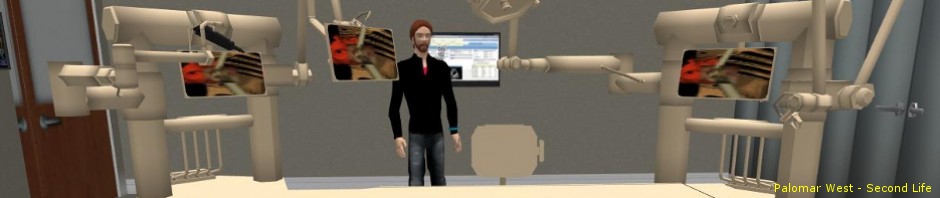
Here’s a screen shot of Knoh Oh at the Ann Myers Medical Center’s Admission Desk checking out the day’s schedule. To the right of Knoh is an Electronic Medical Record and Clinical Information System application being accessed from within the Second Life client.
It’s more of a proof of concept than anything else, but it does work, and I think would help enhance medical simulations. I could also see it as a great way to train people on how to use the software. One could have several people accessing the same EMR/CIS system in various areas of the hospital sim and run patient’s around.
I hijacked the SL client’s help window, and through it logged into an open source medical software demo. (Technical details at end.)
One of the great advantages to open source is that you really can get the code for free/cheap. Further, since there are no proprietary secrets, there is no reason to hide the software, so the software is easy to try. There are several open source medical software vendors, a few have on-line demo sites, some even have live CD’s one can easily boot up on one’s own PC’s. Wikipedia has a nice list of Free and Open Source Medical Software. One can set up the software and allow others to access it without worrying about licenses.
What I did not do, was create an actual object in SL. No other avatar can look over Knoh’s shoulder and see the screen. It is like a HUD- part of my client. However, other people can log into the same EMR/CIS and use the system as I am. You would get the same result by running the EMR/CIS in a separate browser…just not as cool screenshots
This particular picture features the ClearHealth software running from their demo site. I cannot vouch for their software, but it seems to be of the right weight, covers a multitude of tasks, and works well in the window. Big thanks to ClearHealth for providing an online demo! (I have not spoken to them about it yet.)

How did I do this? A bit of background for some, but the in-world help screen can be used as a web browser (recent Windows SL client, YMMV.) In the SL client go to the toolbar’s drop down “Help” then “In-World Help”. Paste in a URL into the help’s search window and hit return.
PLEASE DO NOT ABUSE THE DEMOS. These companies pay for their bandwidth and need to maintain their severs. If you really want to utilize a particular vendor’s service, contact them. They will most likely be happy to help you out.
THX to ClearHealth and Ann Myers Medical Center who had no idea what I was up to, but are hopefully cool with it.
Tags: Medical Informatics
December 19th, 2007 · 2 Comments
Best to be ready when the mood strikes-
Hipster template with finger puppets and Shakespeare.
Hamster pdf
Hamster Scribus source
Released under Creative Commons 2.0
Attribution ShareAlike license
Tags: Hipster PDA
December 17th, 2007 · 2 Comments
Print out this file and with a little paper craft you can have
a circular slide rule addition
to your hipster.
(Use clear plastic for the cursor.)
Many thanks to Charles Kankelborg.
Circular Slide Rule PDF
Circular Slide Rule Scribus source
Tags: Hipster PDA